Thursday, July 6, 2017

Volvo Commits to Electrification


In a bold announcement this week, Volvo has declared that every car in its lineup will have at least one electric drivetrain motor by 2019. This puts the Swedish brand in a unique position as the first mainstream automaker to fully embrace electric power. Indeed, Volvo has committed itself to an electrified future from the moment it put together a plan to revamp its entire lineup.

Volvo's product plan moving forward is incredibly simple. The brand will focus on three key models in three different sizes. Each size range of vehicles will include a sedan, an SUV, and a wagon. So far only the large 90 series of vehicles has been brought to market. All 90 series cars, as well as the upcoming range of 60 series cars, ride on the same Scalable Product Architecture (SPA). Easing the transition to electric power and avoiding the packaging problems that come from adding extra motors and batteries, SPA was designed from the start to accommodate hybrid and electric powertrains. The same can be said of the smaller Compact Modular Architecture which will underpin a range of 40 series models.

Volvo's only hybrid vehicle at the moment is the plug-in XC90 T8. Dubbed "Twin-Engine," a rear mounted 87 hp electric motor powers the rear wheels while a smaller 46 horsepower motor provides power to the front wheels when needed. The electric motors combine with the four cylinder turbocharged and supercharged gasoline engine for a total system output of 400 hp and 472 lb-ft of torque. This October, the 2018 XC60 T8 will debut using the same setup as its bigger brother. 

High performance electric vehicles are also on the table, and will be sold under the Polestar brand. Polestar has origins in Volvo's motorsports program, making championship winning homologations for various European touring car series. Polestar was purchased by Volvo in 2015 and has assisted in the development of sporty versions of the S60 and V60, sort of like BMW's M division. As separate brands, the relationship between Volvo and Polestar will be similar to that of Hyundai and Genesis. Polestar and Volvo models will share chassis, electronics, and powertrains together. Regular Volvo models fettled by Polestar will carry the "Polestar Engineered" label.

Full details are scant at the moment, but Volvo has promised to provide more details sometime in the fall. Volvo boldly hopes to sell 1 million electric cars by 2025. That would require a substantial increase in market share since the brand only sold 534,000 cars in 2016. Nevertheless, plentiful money supplied by parent company Geely puts Volvo in a much better position to achieve its dreams.

Monday, May 29, 2017

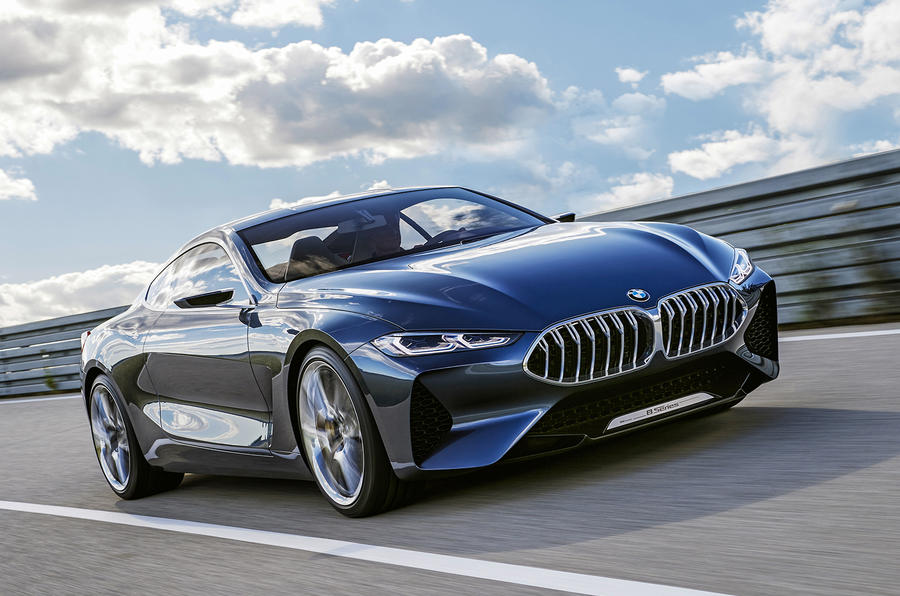
Big Shakeup at BMW

BMW revealed images of the 8-series concept ahead of
its debut at Italy's Ville d'Este concours on Lake Como.

BMW is making a major change to its lineup with the return of the 8-series coupe. The announcement came after BMW ceased production of the current 6-series coupe for North America, leaving only the convertible and the Gran Coupe for the remainder of 2017.

Surprisingly, we have heard a similar story before. BMW replaced the E24 6-series with the original 8-series in 1989 as it sought to move beyond the E24's market with increased performance and a higher price tag. The 8-series remained in production until 1999, by which time around 30,000 units had been sold globally. BMW fans were left without a large coupe until the E63 6-series appeared in 2003.

Now, the 2018 8-series will surpass the current 6-series with heightened levels of luxury and performance. It will be built using 7-series architecture, allowing it to compete confidently with the Mercedes-Benz S-class coupe, the Lexus LC, and perhaps a couple of models from Bentley and Aston Martin. BMW insiders have divulged that the 8-Series will share the 7-series' partial carbon fiber construction to reduce weight and improve handling.

Connectivity is just as important as driving dynamics nowadays, and the 8-series debuts BMW's next generation iDrive architecture. Information is grouped in distinct clusters which promise to be easy to navigate. In the concept, the iDrive rotary controller is made from Swarovski glass with a smoked quartz finish.

A turbocharged 3.0-liter inline six is expected to power base versions of the car. Above that, we can expect the twin turbo 4.4-liter V8 from the 750i. An eight speed automatic gearbox will be standard, and all wheel drive will be available as an option. A convertible and a four door Gran Coupe will appear later. Rounding out the new 8-series lineup will be a M8 and a M8 GTE to be raced at Le Mans. That car will debut at the 2018 Rolex 24 at Daytona. 

Meanwhile the 6-series badge will persist on the back of the replacement for the 5-series Gran Turismo. A prototype has been spotted testing on the streets of Germany and at the Nurburgring. The 5-series Gran Turismo was a Frankenstein-esque creation based on what market researchers determined people want in their perfect car. Apparently they wanted a car with the roominess of a 7-series, the headroom of a X5, the cargo carrying capacity of a station wagon, and the versatility of a MPV. The 5-series GT rode higher than the regular 5-series, but not as high as a X5 or a X6, and featured sliding rear seats. The trunk could be opened entirely, like a hatchback, or partially, like a sedan. Sales in the United States never took off, and the model's future was left uncertain following the redesign of the core 5-series family.

The new 6-series GT should be more aesthetically pleasing than the old one. Video footage of the car shows that the roofline has a more graceful curve and the rear appears less slab sided. Perhaps it will be like a Porsche Panamera that has been stretched heightwise. It will utilize the long wheelbase 5-series architecture currently only offered in China. The only model that has been confirmed so far for the US market is a 640xi with the turbocharged 3.0-liter six mentioned earlier and standard all wheel drive. It seems reasonable to expect a hybrid powertrain and a more powerful M Performance version to follow. The 640xi will go on sale in the US this September.

Sunday, April 16, 2017

Classifying Boring

The 2018 Toyota Camry received plenty of attention at the Detroit Auto Show. I noticed that it follows the latest design trend of incorporating a floating roof. But this is just one of the differences between this version and the outgoing Camry. Efforts have been made to make the Camry look like a junior Lexus. The taillights borrow styling cues from the LC500 coupe and the fascia is reminiscent of what is seen across the Lexus lineup. Overall, it builds upon the styling of the current Camry by making every line edgier and more aggressive.

Toyota CEO Akio Toyoda has made a vow to no longer produce "boring" cars. He points to the new Camry, the C-HR, and the 2017 Prius as examples of how he is trying to change his company's stodgy image around.

Toyota cars of the past have been generically styled for good reason. Increased design details require more specialized production methods, which in turn increases the risk of defects. However, new metal stamping innovations have made it possible to recreate designers' sharp creases and edges without splintering the sheetmetal in the factory.

Expressive styling is all well and good, but Toyoda seems to be missing the point in what makes a car less boring. After all, BMW cars are promoted as the ultimate driving machines, yet they have followed the same basic design style for more than 30 years. In a recent Car and Driver comparison test, the Toyota Prius Prime was soundly beaten by the Chevrolet Volt. The editors deducted points for the Toyota's styling which they thought was overwrought at best and offensive at worst. They joked that the car's excellent coefficient of drag is due to the air refusing to touch anything so ugly. Compared to the Volt, the Prius was measured at being slower and less efficient to run. If Toyota is serious about building exciting cars, they should start with the powertrains and then choose a design.

Toyota's signature technology remains its hybrid synergy drive. Toyota offers a hybrid options on four of its models in addition to four separate Prius models. Perhaps Toyota could reposition its hybrids as sporty options much like Porsche has done with the recently unveiled Panamera Turbo S E-Hybrid. That car builds upon technology first introduced in the 918 Spyder. It is able to deliver astonishing performance figures considering its hefty weight. Can you think of any other car which weighs 5200 lbs., yet can accelerate from 0-60 mph in 3.2 seconds? Porsche is committed to hybrid technology development as a means to reduce dependence on fossil fuels. However, they are not leaving driving enthusiasts empty handed. The message that Porsche is preaching is if you want the fastest one, you need to get the hybrid.

Right now Toyota is painting itself into a no-win situation. It is creating edgy cars yet is not giving them the sporty performance such looks suggest. On the other hand, I'm afraid that those who appreciated Toyota's conservative styling approach will feel alienated by their new design direction. They will likely flock to Honda, Ford, or Chevrolet which offer tastefully elegant cars along with engaging driving dynamics. 

Wednesday, March 8, 2017

General Motors Sells Opel to PSA

Two days ago General Motors sold its Opel and Vauxhall brands to the PSA Group for 1.8 billion euros ($1.9 billion).  By combining Opel and Vauxhall with PSA’s range of  Peugeot, Citroen, and DS cars, the group is now the second largest auto manufacturer in Europe behind the Volkswagen Group.  GM executives stated that the sale of Opel is due to the increasing level of investment required to make their cars competitive in the European market.  They believe that money can be better used to grow sales in North America and China, as well as continue development on electric powertrains and autonomous driving.  For years Opel has been plagued with rising debt and decreasing market share on the European continent.  Both of which have hurt GM’s bottom line.
At one point in the 1970s, Opels were renowned for their reliability, and were held in the same esteem as Volkswagens.  Then GM appointed Jose Ignacio Lopez to improve the brand’s profitability.  Lopez went on a cost cutting spree which significantly reduced quality across Opel’s lineup.  Opel saw its market share in Germany drop from 17 percent in 1995 to 8.4 percent in 2008.  Meanwhile, the Great Recession caused all car sales to drop to 20 year lows, and Opel’s European workforce shrank from 50,000 to 35,000.  Uncertainty over the brand’s future as the economy limped along cost Opel even more sales with German volume dropping to 5.2 percent in 2012.  Although Opel has produced some good cars in recently, it has also recorded 17 straight years of financial losses.
It remains to be seen what will become of Opel as a brand.  Both PSA CEO Carlos Tavares and General Motors CEO Mary Barra appear to have faith that the brand will survive.  Opel vehicles are imported to the United States as Buicks, and have done much to improve Buick’s image.  During the annoucement, GM promised that Opel will continue to provide Buick with vehicles for the foreseeable future.  Tavares has reportedly stated that he hopes to take the Opel brand to markets where French cars are viewed unfavorably.  Current Opel CEO Karl-Thomas Neumann is said to be working on a plan to turn Opel into an electric-only brand.  The potentially game-changing Ampera-e based on the Chevrolet Bolt has just entered production.  It offers a driving range of 500 kilometers, and beats a similar model from Volkswagen to market by three years.  By the time the Volkswagen appears, Opel will hopefully already have a strong grip on the electric car market.
These promising reports aside, I don’t see much future for the Opel brand, at least in Europe.  Currently, PSA has three main brands each covering a segment of the market.  Citroen serves as the group’s entry level brand offering inexpensive cars for buyers on tight budgets.  Peugeot is the middle brand with similar models as Citroen, but built with a few more features and upmarket styling cues.  The recently introduced DS brand hopes to lure BMW, Audi, and Mercedes buyers looking for something different.  There is not much room for Opel to fit in.  Most if not all of its cars compete directly with a corresponding PSA model.  Each brand’s lineup would have to be cut down to prevent too much overlap, and I’d be willing to bet that Tavares would be more reluctant to trim models from his flagship brands than he would from adopted Opel.  Moving Opel out of Europe could work, and it is possible that it can become PSA’s electric car brand.  We will have to wait and see what transpires in the coming years before an accurate picture can emerge.

Tuesday, February 14, 2017

Also Ran Anime

I tend to write about anime that I really enjoyed watching.  So, if you see a review on this blog, it usually means I have high praise for it.  Today I am going to share my brief thoughts on a couple series that I have watched in their entirety but would not give my top notch rating.  This isn't to say that these shows are absolutely terrible; you might actually enjoy watching them.  They simply didn't resonate with me the same way as others that you have already read about on this blog.

Monthly Girls' Nozaki-kun

School Rumble is one of my favorite if not my absolute favorite anime.  The mix of humor, romance, and action combined with interesting and compelling characters immediately hooked me into the series.  I was hoping that Monthly Girls' Nozaki-kun would do the same.  The premise appeared similar enough: high school romance, a character who looks to real life for inspiration for his manga, comedy--everything is there. 

Consider me somewhat disappointed.  First, let's deal with the romance.  Sixteen year old Chiyo Sakura is hopelessly in love with Umetaro Nozaki.  One day when she finds the courage to confess her feelings to him, Nozaki interprets this as her desire to become his assistant.  Nozaki is a popular shojo manga artist outside of school, and brings Chiyo to his apartment to ink some of his stories.  Once with Nozaki, Chiyo makes numerous advances on him, but they end up completely going over his head.  It's not like Chiyo is being subtle either.  Nozaki has to be the densest guy on the face of the earth to not realize how badly Chiyo is crushing on him.  Or is he?  For one thing, the heroine of Nozaki's manga looks exactly like Chiyo.  In fact, the manga explains that her design is based on Nozaki's first meeting with Chiyo where she gave him one of the ribbons in her hair.  In the final episode of the anime, Chiyo and Nozaki almost recreate their first encounter, which nearly seems to make Nozaki finally understand Chiyo's feelings as well as his own.  Unfortunately a series of fireworks interrupts them before either can make a confession. 

The comedy is okay.  Most of it revolves around misunderstandings and failures of characters to confess their romantic feelings.  In this regard, it is quite similar to School Rumble, but whereas School Rumble's comedy feels natural, some of the characters' antics here seem just plain annoying at times.  Through Nozaki, Chiyo meets Mikoto Mikoshiba who draws artistic effects, and is unknowingly the inspiration behind Nozaki's heroine character.  She also gets to know Masayuki Hori who designs the backgrounds for Nozaki's stories in exchange for Nozaki writing him scripts to be used in his drama club.  Other characters include Chiyo's friend, Yuzuki Seo; Mikoshiba's friend, Yu Kashima; and Hirotaka Wakamatsu, who is a skilled basketball player and eventually helps Nozaki by doing screentones.  Most of the humor stems from Mikoshiba who despite being very flirtatious is actually painfully shy and insecure.  He immediately regrets any embarrassing things he says.  Kashima is considered to be the top prince of the school despite being a girl.  She is also incredibly dense and annoys Hori to the point where he physically beats her.  Seo is brash, and belligerent, and is incapable of reading situations.  Nozaki ends up observing her and Kashima for ideas for his stories. 

My favorite part of the series is how it shows, albeit in a roundabout way, the processes involved in creating a manga.  The audience follows Nozaki as he tries to come up with new story ideas.  Then we actually see him, Chiyo, and the others work on individual components of the piece.  We also see interaction between Nozaki and his editor which some writers may find relatable to some degree.

Monthly Girls' Nozaki-kun got a few chuckles out of me, but I'd give this show a higher rating if something noteworthy actually happened.  The short run of 12 episodes ends with little development among the main characters.  It's good for a quick laugh, and provides insight into the manga creation process aspiring authors may find useful, but nothing about it begs you to watch it again and again.   

Rosario + Vampire

Harem series are difficult to do well.  On one extreme, you can lose the audience in the romantic rivalry between the suitors and forget to tell an actual story.  On the other, you can tell a story, but fill it with such forgettable characters that viewers simply don't care.  Rosario + Vampire is not great, and that's a shame considering its premise.  Tsukune Aono is the averagest of average high school boys.  He accidentally gets enrolled in a school called Yokai Academy where all the other students and faculty are monsters.  Any human who is caught on the school grounds shall be immediately killed.  The only thing keeping Tsukune from going completely insane is a female classmate named Moka Akashiya.  Moka crashes into Tsukune on her bike as they both arrive at the school, and she reveals that she is a vampire.  At first, Tsukune is horrified, but warms to Moka's sweet personality. 

During an encounter with a bully, Tsukune removes the rosary around Moka's neck which releases her aloof and aggressive inner personality.  The series continues with Tsukune and Moka making new friends including the succubus, Kurumu; the snow fairy, Mizore; and the witch, Yukari.  All of the girls fall in love with Tsukune due to the kindness he shows them while helping them with their problems.  Despite their constant advances on him, Moka remains Tsukune's primary love interest.

The whole ghoul school gimmick is nothing new.  However, there are several directions that idea can run, which, if handled correctly, can produce solid results.  You could have something like the X-Men, where young monsters go to school to master their abilities.  Yokai Academy takes a different route.  Rather than encourage monsters to show their true nature, the school teaches peaceful coexistence with humans and wants its students to act as human as possible.  Nevertheless, prejudices toward humans remain, making the idea of coexistence difficult.  The overall storyline of the first season sees Tsukune try to keep his human nature secret, even from his friends.  Moka is the only one who knows Tsukune is a human.  Each episode deals with an antagonistic student or teacher who Tsukune and his friends have to defeat.  It's fairly repetitive, but gives some quick facts about monsters from different cultures. 
 
The season cumulates in an intense showdown with the Yokai Academy Security Committee who put Tsukune on trial for being a human.  His friends learn the truth about Tsukune's identity, yet put aside their prejudices to save him from being burned alive.     

The more I think about it, the first season is pretty decent.  It's the second season where everything falls apart.  It offers literally nothing new to the universe.  The story threads are stupid and lead nowhere.  That being said, the manga of Rosario + Vampire is much better, and I encourage people who have seen the first season of the anime to give the manga a look.  You'll find some interesting stories and genuine story arcs with rewarding outcomes.

There are a couple other anime that I could add to this list.  But I thought I would include these two since they have some redeeming qualities.  Look for other reviews in the future.  I have a few in the pipeline that I think you will like.

Saturday, January 28, 2017

Detroit 2017 is the year of the Floating Roof

Of all of the new cars unveiled at the 2017 Detroit Auto Show, I think that most will agree that this is the year that the floating roof entered the mainstream.  Automakers are increasing looking for ways to be expressive in their designs as regulations push them closer to homogeneity.  One of the ways automakers have been able to do that is with a floating roof.

The idea of a floating roof is less complex than it sounds.  It involves the C pillar being painted in black to blend in with the rear side windows.  Nissan was an early adopter of this design trend, utilizing a floating roof on the Maxima and the Murano.  Toyota followed next by including floating roofs on the latest Prius and the Lexus RX.  Now it seems like a floating roof is the latest design trend to make a car look more futuristic after LED lights and digital display screens.  No less than three all new cars debuted at Detroit with either a standard or optional floating roof.  All of these cars compete in hotly contested segments, and come equipped with other features to help them stand out from the crowd.  


2018 Toyota Camry
It seems like just yesterday that the Toyota Camry was redesigned for 2014.  As part of CEO Akio Toyoda's quest to inject more passion into his cars, the Camry has been treated to yet another update.  Four trim levels are offered: LE, XLE, SE, and XSE.  A hybrid model returns, too.  Surprisingly, as many automakers move to smaller turbocharged engines for their performance models, a V-6 engine is still available in the SE and XSE.  Styling across the lineup is more aggressive with sharp lines designed to mimic those of sister brand, Lexus.  The rear vents underneath the taillights appear taken directly from the Lexus LC500.  It is unclear which trim levels will receive the floating roof.  At least the XSE will get it, but it might be a bit extreme for the hybrid models.


2018 GMC Terrain
I know that the Terrain has been around for a long time.  It debuted for 2010 shortly after GM's bankruptcy to fill the void left by the departed Pontiac Torrent as a platform partner for the Chevy Equinox.  While the Equinox was a popular seller, the Terrain never really generated comparable numbers.  GM has fixed a lot of those problems for 2018.  The new Terrain is much lighter, having lost 465 pounds.  It's also 3.2 inches shorter and 0.4 inches narrower.  The floating roof design element gives the car an air of lightness lacking in the original car.  Unlike the Camry mentioned above, the Terrain is turbo-only.  No six cylinder engines are offered.  Perhaps the strangest change to the Terrain is the deletion of a conventional shift lever.  In its place is a horizontal arrangement of buttons and levers to select gears.  Park, neutral, and low are selected by pushing buttons.  Reverse and drive are activated by pulling up on switches that resemble window controls.  It seems like a case of reinventing the wheel, but GMC claims that removing the gear lever frees up space for storage, something that people buying crossovers look for.  Now there is a place for passengers to put their phone or music player within convenient reach of two USB ports.


2018 Honda Odyssey
Honda is keeping the minivan segment alive with the completely new Odyssey.  Following the template set by the Chrysler Pacifica, Honda made a great effort to make the Odyssey more aesthetically pleasing.  It utilizes Honda's current corporate face, and has character lines along the side panels similar to the old Mazda 5.  The floating roof works well here given the vast size of the C pillar.  Gimmicky features include CabinTalk which allows the driver to speak to passengers through the audio system.  Toyota already has something like this.  Hard to believe someone can be so engrossed in whatever they are listening to that they can't notice someone talking to them from ten feet away.  Another feature is called CabinWatch which displays a live feed from the middle row of seats on the infotainment screen, because it is clearly so difficult to turn your head to see what's going on behind you.  Honestly, technology for the sake of technology makes me sick.  I remember when my mom drove my family around in her minivan.  There was no advanced driver aids.  If we wanted entertainment, we listened to CD players--the car's cassette player never worked--or we read books.  Being a car enthusiast, I mostly just stared out the window and identified passing cars.  If my sister and I really needed something to distract us on long road trips, we folded the middle row down, strapped a small TV on top of it, and watched VHS tapes.  It was powered by the van's cigarette lighter.  Minivans today might as well be top of the line RVs compared to when I was a kid.

Wow, that got unexpectedly heated.  Anyway, floating roofs are now in vogue and we should expect them to appear on numerous cars in the next few years.


Saturday, December 17, 2016

Subaru Thinks it's the Budget Audi


Subaru, that quirky little manufacturer from Japan, has issued a bold claim that radiates confidence within the organization.  With the introduction of the brand new 2017 Subaru Impreza, Subaru hopes that buyers will consider it to be a budget alternative to an Audi A3. 

Perhaps Subaru's desire to stand toe-to-toe with Audi comes from a Consumer Reports reliability survey in 2016 where both Audi and Subaru were ranked at the top among automakers who make the best cars.  This cumulative score is calculated from overall vehicle scores, road test scores, and predicted vehicle reliability scores for every model in an automaker's lineup.  Last year, both Subaru and Audi were among the top five brands for highest predicted new car reliability in Consumer Reports.  For 2017, Audi remains in the top five, but Subaru has fallen to 11th.  Multiple problems with the Legacy and the Outback as well as falling ratings for the WRX/STI are responsible for the overall drop.

I will assume that Subaru is serious about comparing itself to one of the finest automakers from Germany, even though I have only found this claim cited in one article from Car and Driver.  In this post, I will explore what similarities already exist between the two automakers and how the 2017 Impreza represents a new era for design, quality, and dynamics.

The 2017 Impreza wears some of the
most attractive bodywork yet seen on a Subaru.
All Wheel Drive
When you think of Audi or Subaru, chances are you think of both company's commitment to all wheel drive.  Every Subaru model save for the BRZ comes standard with all wheel drive.  Likewise, every model in Audi's lineup has all wheel drive as an option if not standard.  People in the Northeast and the Northwest appreciate this option to help them deal with inclement weather.  Other luxury and non-luxury manufacturers have adopted all wheel drive on their models to better compete in these particular markets.

Motorsports
Both Audi and Subaru also have a history in motorsports.  Subaru was a staple of the World Rally Championship in the 1990s and the 2000s before pulling out after the 2008 season.  Highlights of the Subaru World Rally team include three consecutive manufacturer championships from 1995 to 1997.  Legendary driver Colin McRae won the driver's championship in 1995 driving for Subaru, and the team won two other drivers championships with Richard Burns and Petter Solberg in 2001 and 2003 respectively.

Audi also has a rallying history.  The Audi Quattro won two manufacturers championships and two drivers championships between 1982 and 1984.  In addition, the automaker has seen great success in endurance racing for over a decade.  Since the first Audi World Endurance Championship prototype appeared in 1999, the manufacturer has gone on to win 13 overall victories at the 24 Hours of Le Mans. Unfortunately, Audi closed its factory racing program at the end of this year due to regularly being outperformed by its sister Porsche team, plus a companywide tightening of budgets following the Volkswagen Group Dieselgate crisis.  Audi will instead compete with a factory race team in the FIA Formula E open-wheel series.  Costs should be significantly less than for WEC, and the series can only benefit from the money and reputation Audi brings to the table.  The Formula E Series also complements Audi's new focus on promoting electric powertrains as the way of the future.

The interior of the 2017 Impreza is modern and attractive.
You can see the Eyesight cameras above the mirror.
Technology
Audi's longtime slogan was Innovation through Technology, and the company prides itself on being at the forefront of the latest technological trends.  Audi was the first mass market automaker to produce 100% galvanized cars to prevent corrosion.  It was also the first to implement LED daytime running lights on a production car.  Audi's multimedia interface has been widely praised for its ease of use over several generations.  New Audi models feature a virtual cockpit where the entire instrument panel in front of the driver is a single TFT LCD screen.  Subaru's latest technological endeavor is its Eyesight driver assistance system.  Stereoscopic cameras situated above the rearview mirror determine the distance between the car and an object ahead of it.  If the object gets within 19 feet of the car, the brake pedal is automatically applied.  Other automakers such as Mercedes-Benz and Volvo have similar systems, but Subaru, which introduced Eyesight in 2012, brought the technology to a lower price point.

Design
Audi has produced some stunning cars over the years including the A5, the A7, and the R8; Subaru, not so much.  The best looking Subaru in recent memory is the BRZ, which was designed by Toyota.  That being said, the new 2017 Impreza is far more handsome than its predecessor.  The interior also makes big improvements in terms of fit and finish.  Available options include a Harman/Kardon stereo and an 8 inch high resolution touch screen.  Quicker steering and a stiffer platform help the new Impreza drive better, too.  Speaking of its platform, the 2017 Impreza is the first Subaru to ride on the company's new global platform which will eventually be used on all Subaru models.  This is similar to how the Volkswagen Group is able to put compact hatchbacks, SUVs, and sports cars on common platforms.

The new Impreza is a promising step forward for Subaru, and the Viziv-7 concept previews a lucrative three row crossover to replace the unloved Tribeca.  Although Subaru may not yet be the budget Audi it aspires to, the literal budget Audi, Volkswagen, lags Subaru significantly in sales despite having a very similar lineup.  Subaru is on a roll right now, so Volkswagen should better watch out.